Timing decides more here than formulation does. Nothing goes on a surgical incision until it has fully closed and the operating surgeon has cleared it, and that applies to silicone gel exactly as much as it applies to any cream on this page. Sutures, steri-strips, dressings and surgical glue all run on different schedules.
That clearance usually comes a few weeks after surgery, but the only person who can give you a date is the surgeon who made the incision. What follows assumes you already have it. If you’re still in the closed-dressing stage, bookmark this and come back.
Quick answer: BIOCORNEUM is the pick for most people because it combines medical-grade silicone with SPF 30, and sun exposure is what makes an immature scar darken permanently. HealFast and Mitgary are lower-cost silicone gels, Skinuva adds growth-factor peptides, and Mederma PM is the weakest evidence on this list.

Pros
- Specifically formulated to work with nighttime skin repair
- May show visible improvement in two weeks
- HSA and FSA eligible purchase
Cons
- Limited ingredient transparency in available product data
- Single 1-ounce size may require frequent repurchasing
Pros
- Specifically formulated to work with nighttime skin repair
- May show visible improvement in two weeks
- HSA and FSA eligible purchase
Cons
- Limited ingredient transparency in available product data
- Single 1-ounce size may require frequent repurchasing
- Triple action system penetrates beneath skin surface to support moisture retention and collagen production while targeting discoloration and texture irregularities from acne, surgery, burns, and injuries.
- White cream texture designed for once-nightly application on clean skin, suitable for use alone or after lightweight serums but before heavier occlusive moisturizers in PM routines.
- Triple Action Complex: proprietary blend formulated to penetrate skin layers, support moisture barrier function, and work with nocturnal cell renewal processes.
- Collagen Support Actives: ingredients designed to support skin's natural collagen production during overnight repair cycles when cell regeneration peaks.
- Moisture-Locking Agents: humectants and emollients that maintain hydration levels in scar tissue to help improve texture pliability and appearance.

Pros
- Silicone-based formula creates protective barrier over scars
- Suitable for face, body, and sensitive skin
- Free of preservatives and sulfates
Cons
- Results require 8 weeks to 6 months
- No reviews available to verify efficacy claims
Pros
- Silicone-based formula creates protective barrier over scars
- Suitable for face, body, and sensitive skin
- Free of preservatives and sulfates
Cons
- Results require 8 weeks to 6 months
- No reviews available to verify efficacy claims
- Silicone gel forms an occlusive layer that locks moisture in to support collagen formation, targeting surgical scars, keloids, acne marks, and stretch marks on all skin types including sensitive.
- Smooth, non-greasy texture absorbs quickly for twice-daily application morning and evening, layer under sunscreen during day or alone at night on clean skin.
- Silicone: creates protective barrier that supports moisture retention and may help improve scar texture over time.
- Not specified: brand does not disclose additional active ingredients beyond silicone base in available product data.

How We Evaluated These Scar Treatments
Nobody here followed a scar through eighteen months of healing. What decided the list was the evidence hierarchy, which in scar management is unusually clear: silicone, applied consistently to a closed incision, is the best-supported non-invasive option and it is what plastic surgery guidance actually recommends. Sheets have marginally better data than gels, but adhesion on a curved, mobile area like the breast is a real practical problem, which is why gels dominate this category and why four of our five picks are gel formulations.
From there we screened on what the formulas leave out. Vitamin E is the notable exclusion. It has a documented contact dermatitis rate and at least one controlled study where outcomes were worse than the control, so a product leaning on it lost ground rather than gained it. Onion extract and cocoa butter fall into the same weak-or-absent-evidence bucket. Verified-buyer feedback settled questions of texture and wear under a bra or compression garment.
BIOCORNEUM Silicone Scar Gel with SPF 30 — Best overall
The SPF is why this one leads. UV exposure on an immature scar drives hyperpigmentation that becomes permanent, and a breast scar that sits near a neckline gets more incidental sun than people expect. Getting silicone occlusion and broad-spectrum protection from a single step removes the most commonly skipped part of the routine. Its Silishield technology self-dries into a flexible sheet, which matters on tissue that moves every time you raise your arm. It’s the most expensive option here by a clear margin, and the tube is small enough that a long incision will go through it quickly.
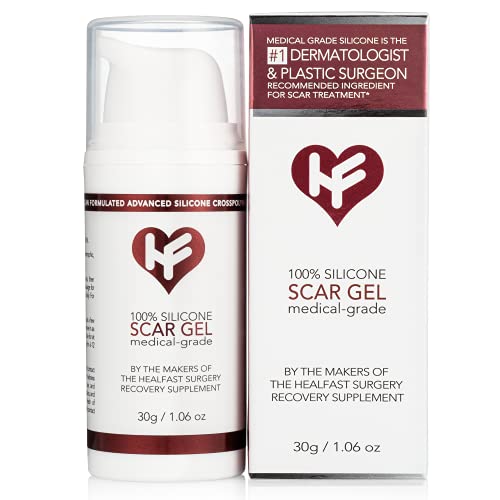
HealFast Silicone Scar Gel — Best value silicone
Straightforward medical-grade silicone without the extras, priced well below the branded clinical options. For someone treating a reduction or augmentation incision who will be applying twice daily for six months or more, the cost per month matters more than any single feature, and this is where the arithmetic lands. It dries clear and thin. What you don’t get is sun protection, so this needs a separate sunscreen over the top once the scar is exposed to daylight, and forgetting that step undoes a meaningful share of the benefit.
Mitgary Advanced Scar Gel — Best for older scars
Worth being precise about what “treats old scars” means. Silicone has its strongest effect on immature scars, roughly the first year, and a scar that’s three years old is far less responsive to anything topical. This gel is a reasonable choice if you’re revisiting a mastectomy or reconstruction scar from a previous surgery, provided expectations stay modest: softening and colour improvement rather than resolution. The texture is on the thicker side of the silicone gels here, which some people prefer overnight and others find tacky under a garment.
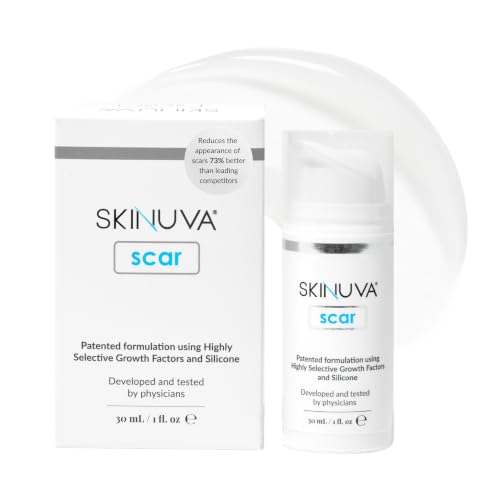
Skinuva Scar Cream — Best peptide formulation
Skinuva’s pitch is a growth-factor and peptide complex alongside its silicone base, and it’s the only product here making that argument. The peptide research is genuinely interesting and genuinely early, so treat the silicone as the part doing reliable work and the peptides as an unproven addition you’re paying for. It’s a cream rather than a self-drying gel, which makes it more comfortable on sensitive post-surgical skin but less useful if you need something that won’t transfer onto fabric. Popular with plastic surgery patients, and priced accordingly.
Mederma PM Intensive Overnight — Weakest evidence here
Mederma is the name most people recognise, which is exactly why it needs the honest treatment. The formula’s history is built on onion bulb extract, an ingredient whose scar data has never been convincing, and the overnight positioning is marketing structure rather than a mechanism. It’s pleasant to use, widely available, and it will keep the scar hydrated, which is not nothing. But if you’re choosing one product for a surgical scar and you want the option with actual guideline support behind it, choose a silicone gel from the four above instead.
What to Look For in a Post-Surgical Scar Product
Wait for the surgeon’s clearance, then commit to months. The window where a scar responds to intervention is roughly the first twelve to eighteen months, and silicone needs daily application through most of it to do anything measurable. A tube used sporadically for three weeks is money spent on nothing. Set it beside something you already do daily.
Cover the scar from sun for a full year. This is the highest-leverage step after silicone and the one most people neglect, because a breast scar feels hidden. Bathing suits, low necklines and thin summer fabrics all let UV through. Pigment laid down in an immature scar doesn’t fade the way a tan does.
Reduce tension, and take the activity restrictions seriously. Mechanical tension across a healing incision widens the scar, which is the actual reason surgeons prescribe support garments and lifting limits. No cream compensates for ignoring them. Once your surgeon clears massage, the mechanical action does most of the work and the product is largely a lubricant for it.
Frequently Asked Questions
When can I actually start using scar gel after breast surgery?
Only once the incision is fully closed with no scabbing, weeping or open edges, and only after your surgeon confirms it. That’s commonly a few weeks, but glue, dissolvable sutures and drains all change the schedule. Applying anything early risks infection and gains nothing, since silicone works on closed tissue.
Silicone sheets or silicone gel for a breast incision?
Sheets have slightly stronger data, but the breast is curved and moves constantly, so sheets lift and need frequent replacement, especially under a bra. Gel adheres to the contour and survives movement. The best-evidenced option you’ll actually use twice daily beats the marginally better one you abandon.
My scar is getting thicker and raised. Is that normal?
Some firming and raising in the first months is typical and usually settles. A scar that thickens, itches and grows beyond the original incision line may be hypertrophic or keloid, and that needs a clinician rather than a stronger cream. Keloid risk is higher in darker skin tones and with a family history, so mention it to your surgeon before surgery if it applies to you.
What about vitamin E oil? Everyone recommends it.
The recommendation is cultural rather than clinical. Vitamin E has a documented rate of contact dermatitis when applied to healing skin, and controlled work has found no benefit and sometimes worse cosmetic outcomes. If a product’s scar argument rests on vitamin E, that’s a reason to look elsewhere.
When should I contact my surgical team instead of buying a product?
Increasing rather than decreasing pain, spreading redness or warmth, drainage, an opening in the incision, or fever. Those suggest infection and need same-day contact, not a cream. Anything that looks like a sudden change rather than a gradual one is worth a phone call.
Bottom Line
BIOCORNEUM is where we’d send most people, because pairing medical-grade silicone with SPF 30 covers the two interventions that actually change how a scar matures. HealFast is the sensible choice if you’re budgeting for six months of twice-daily use and will layer sunscreen separately. Mitgary suits an older scar with modest expectations, and Skinuva is for someone comfortable paying for early-stage peptide research alongside a solid silicone base. Skip Mederma if evidence is your priority. This article isn’t medical advice, and your surgeon’s instructions override everything in it.