

TL;DR: Polyglutamic acid (PGA) is a peptide-based humectant derived from Bacillus subtilis fermentation. It holds up to 4,000–5,000 times its weight in water — roughly four times what hyaluronic acid holds — and forms a thin breathable film on the skin that locks moisture in. It is not a replacement for hyaluronic acid but a complementary layer that works on a different mechanism.
Polyglutamic acid started appearing in Korean and Japanese formulations around 2019 and reached Western markets through Vichy’s Mineral 89 reformulation and Inkey List’s PGA serum. It is one of the few “hydrators” that genuinely improves on the standard HA + glycerin pairing.
What polyglutamic acid actually is
PGA is a polypeptide — a chain of glutamic acid amino acid units linked together. It is produced via bacterial fermentation (Bacillus subtilis), the same bacterium responsible for natto fermentation in Japanese cuisine. The molecule is significantly larger than hyaluronic acid, which gives it two distinct properties:
- Higher water-binding capacity — 4,000–5,000× its weight in water vs HA’s ~1,000×.
- Film-forming. PGA sits as a thin gel layer on the skin surface, slowing transepidermal water loss like a humectant-occlusive hybrid.
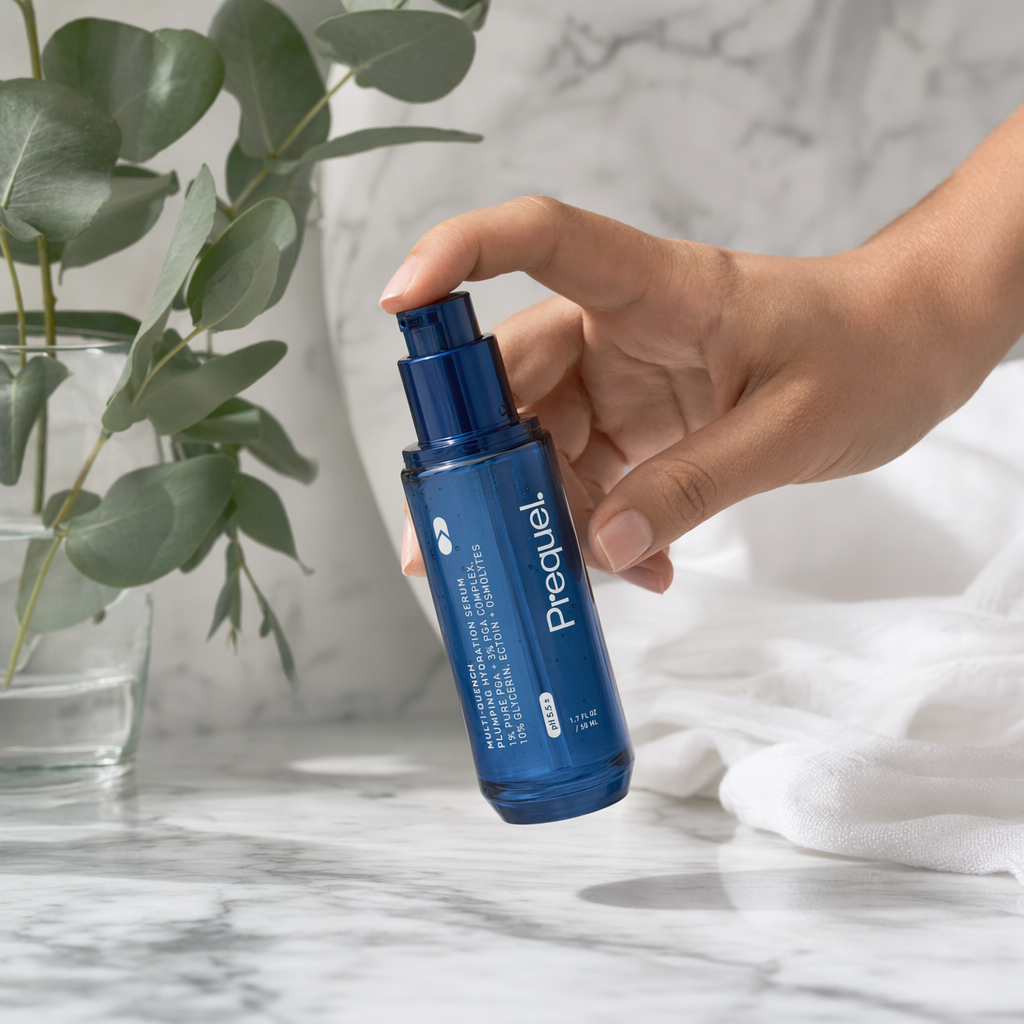
Consistency over weeks produces visible results.
PGA vs hyaluronic acid — not a replacement
The conversation often frames PGA as “better than hyaluronic acid” — it is more accurate to say different. HA is small enough to penetrate the upper stratum corneum and bind water within the skin. PGA is too large to penetrate; it sits on top and seals.
| Hyaluronic Acid | Polyglutamic Acid | |
| Where it works | In the stratum corneum | On the skin surface (film) |
| Water capacity | ~1,000× its weight | ~4,000–5,000× its weight |
| Penetration | Partial (small HA does) | None |
| Mechanism | Volumetric humectant | Surface film + humectant |
| Cost | $ | $$ (production is more expensive) |
The combination is genuinely additive. HA hydrates the inside of the skin; PGA seals the surface. Many high-end Korean serums use both.
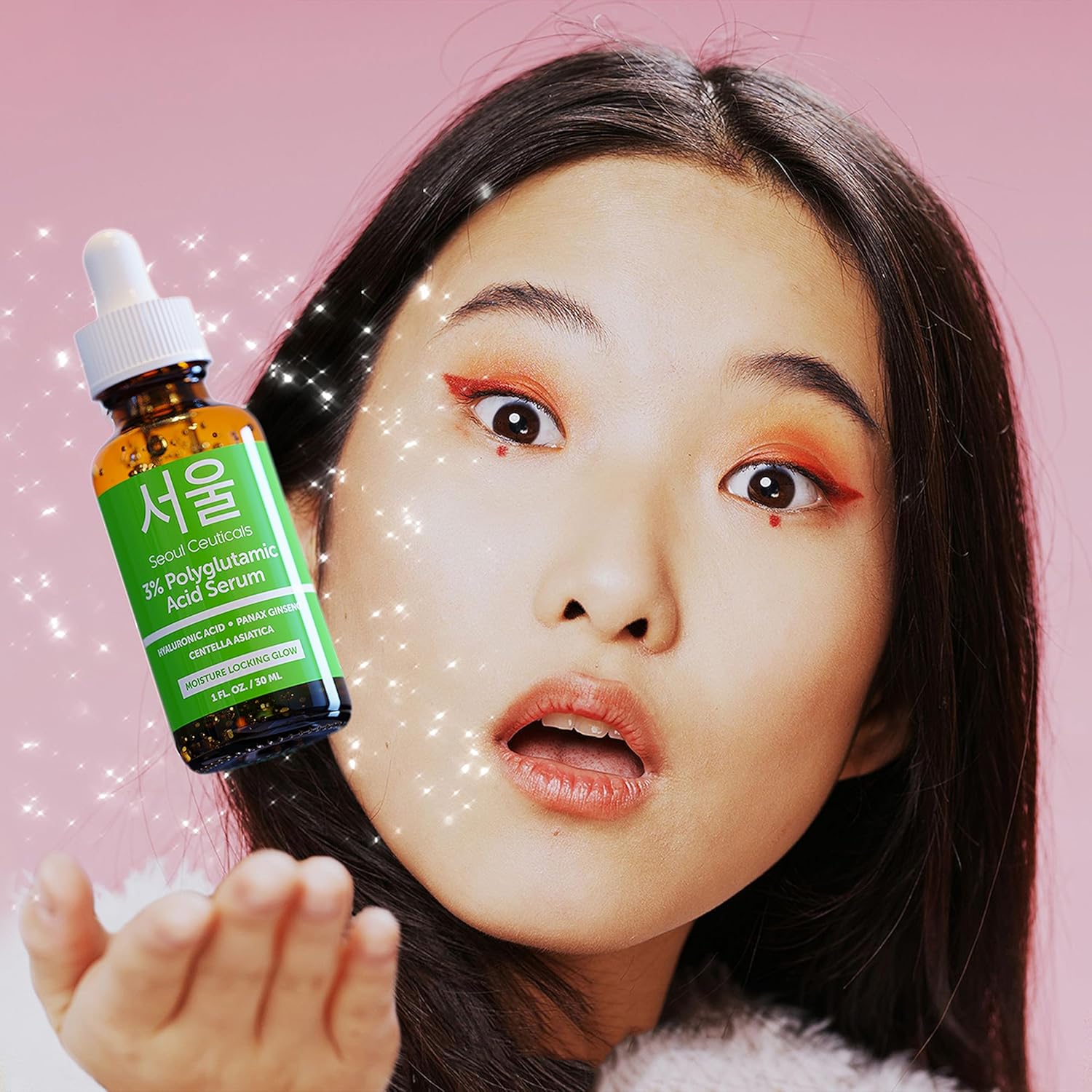
Budget-tier option.
What PGA earns its place doing
- Plumping fine lines temporarily through surface water binding.
- Reducing TEWL on dry or sensitive skin.
- Improving makeup application — the smooth film makes foundation sit better.
- Layering under heavy actives — pairs cleanly with retinoid, AHA, and acid routines as a barrier-support layer.
What PGA does not do
Not anti-aging in the structural sense (no collagen signaling, no exfoliation, no pigment effect). Not a long-term repair active — the effect lasts only as long as you keep applying it. Not a replacement for moisturizer.
How to use it
- Apply to damp skin after cleanser/toner.
- Layer under heavier serums, actives, and moisturizer.
- AM and PM, twice daily is fine.
- Compatible with everything — no active conflicts.
Product picks at a glance

Pros
- Pure active, no fillers diluting concentration.
- Breathable film texture reduces visible dryness.
- Pairs well with hyaluronic acid and niacinamide.
Cons
- Requires DIY formulation knowledge to use correctly.
- No usage percentages specified in product data.

SeoulCeuticals Organic Polyglutamic Acid Serum with Hyaluronic Acid and Centella Asiatica
Pros
- High-concentration PGA supports visible moisture retention.
- Triple-active formula addresses aging and dullness together.
- Broad skin type compatibility, including sensitive skin.
Cons
- Texture and finish not described in available product data.
- No clinical study or independent testing data cited.

Needs Nature Polyglutamic Acid 10% Serum - Hydrating Booster for Dry and Sensitive Skin
Pros
- High-concentration polyglutamic acid for intense hydration.
- Fragrance-free, non-comedogenic, suits sensitive skin.
- Water-light texture absorbs quickly without stickiness.
Cons
- No independent third-party testing data specified.
- Only 30ml, may run out quickly with daily use.
Pros
- High-concentration polyglutamic acid for intense hydration.
- Fragrance-free, non-comedogenic, suits sensitive skin.
- Water-light texture absorbs quickly without stickiness.
Cons
- No independent third-party testing data specified.
- Only 30ml, may run out quickly with daily use.
- Polyglutamic acid at 10% works as a surface humectant, paired with hyaluronic acid to support moisture retention, making it well-suited for dry, dehydrated, or sensitized skin types.
- The water-light, silky texture absorbs without residue and fits both AM and PM routines; layer it under moisturizer and avoid combining with high-strength exfoliating acids in the same step.
- Polyglutamic Acid 10%: Surface humectant that may help visibly plump and retain skin moisture.
- Hyaluronic Acid: Draws water into skin, supporting hydration and barrier comfort.
- Allantoin: Soothing agent that helps calm irritation and supports skin barrier recovery.

Pros
- Dual-acid formula supports immediate and lasting hydration.
- Fragrance-free and suitable for sensitive or eczema-prone skin.
- Lightweight, non-sticky texture absorbs without residue.
Cons
- Small 1.01 fl oz size may run out quickly.
- Plumpness results require consistent use over two months.

Pros
- Polyglutamic acid targets multiple hydration depths simultaneously.
- Fragrance-free and pH-stabilized for reactive skin types.
- Osmolytes support natural moisture balance throughout the day.
Cons
- No independent review data available to validate user experience.
- PGA efficacy relative to hyaluronic acid not third-party verified here.
Frequently asked questions
Should I switch from HA to PGA?
No — pair them. Both target different mechanisms. Use them together for the most comprehensive hydration.
Will PGA make my skin feel sticky?
Slightly tacky for the first 30–60 seconds. The film flattens as it dries. If it stays sticky, you’ve applied too much — a pea-sized amount for the full face is enough.
Can I use PGA during pregnancy?
Yes. It is a fermentation-derived peptide with no documented contraindications.
Does PGA work for oily skin?
Yes — and possibly better than HA for oily skin. The film-forming property does not add oil and the lightweight feel layers cleanly under makeup. Oily skin still needs hydration; PGA delivers it without heaviness.
Related reading
- Best hyaluronic acid serum
- Ectoin — another barrier-support hydrator
- Best skincare for dry skin





Write Your Review
No reviews yet. Be the first to share your experience!