Retinol without a good moisturizer is a common mistake. The dryness and flaking that make people quit retinol aren’t inevitable — they’re mostly a formulation and pairing problem. A retinol moisturizer solves that by building the hydration layer directly into the same step. You get the cell-turnover and smoothing benefits of retinol with the barrier support of ceramides, hyaluronic acid, or peptides working at the same time, in the same product.
The balance matters. Too little retinol and you’re just buying a nice moisturizer with a buzzword on the label. Too much in a thin vehicle and you’re back to the dry, flaky skin that retinol users dread. Our editors assessed these formulas against retinol concentration, vehicle quality, and aggregated verified-buyer feedback covering thousands of reviews. The five below work as standalone evening steps. For pairing guidance, our best retinol for beginners with sensitive skin breakdown covers how to introduce any of these without overloading a new routine.
Quick answer: SimplyVital’s collagen-retinol cream is the most comfortable everyday pick. CeraVe’s retinol serum is the dermatologist-formulated option for barrier-focused users, while Neutrogena’s rapid wrinkle formula suits those wanting faster visible results. Radha Beauty and NatureWell round out the list for body use and budget buyers respectively.

Pros
- Retinol and hyaluronic acid address texture and hydration.
- Doubles as a targeted neck firming cream.
- Suitable for gradual introduction on sensitive skin.
Cons
- Retinol concentration not specified in product data.
- No independent review data available to assess performance.

CeraVe Retinol Serum with Encapsulated Retinol, Niacinamide & Ceramides for Fine Lines
Pros
- Encapsulation may reduce irritation during retinol adjustment
- Ceramide blend supports barrier during active use
- Non-comedogenic texture suitable for oily skin types
Cons
- Retinol concentration not specified in product data
- Requires evening-only application and gradual tolerance building
Pros
- Encapsulation may reduce irritation during retinol adjustment
- Ceramide blend supports barrier during active use
- Non-comedogenic texture suitable for oily skin types
Cons
- Retinol concentration not specified in product data
- Requires evening-only application and gradual tolerance building
- Encapsulated retinol with niacinamide helps visibly refine texture and diminish fine lines while hyaluronic acid maintains hydration, suited for combination to oily skin building retinol tolerance.
- Fragrance-free serum absorbs without heavy residue, designed for evening use only with gradual frequency increase, pairs well with barrier-supporting moisturizers but avoid layering with other actives initially.
- Encapsulated Retinol: MVE Technology supports slow release to help visibly reduce fine lines while minimizing irritation.
- Niacinamide: Helps visibly calm and soothe skin, supporting barrier function during retinoid adjustment.
- Hyaluronic Acid: Humectant that locks moisture into skin for lasting hydration and plumping effect.
- Ceramides 1, 3, 6-II: Lipid blend helps restore and maintain the skin's protective barrier during active use.


Pros
- Targets crepey skin on arms, thighs, and décolletage where smaller retinol formats are cost-prohibitive
- Cream base absorbs in roughly 2 minutes with no significant residue on clothing
- Retinol supported by coconut oil in the base, which helps offset the dryness retinol typically causes
- At roughly $1.25/oz, it's one of the more affordable retinol-containing body creams available at this size
Cons
- Retinol concentration is undisclosed, making it impossible to gauge potency or compare to labeled alternatives
- Jar packaging exposes retinol to repeated air and light contact, accelerating oxidation over the product's life
- Added fragrance in the formula limits use on sensitized, reactive, or rosacea-prone skin
How We Evaluated These Moisturizers
We compared the retinol delivery system first: encapsulated retinol releases slowly and typically causes less irritation, while free retinol hits faster but demands more from the barrier. Vehicle quality matters here as much as percentage. A ceramide-heavy base reduces transepidermal water loss during the adjustment phase, which is weeks one through four when most people either commit to retinol or abandon it.
From there we looked at verified-buyer feedback patterns over months of use, not launch-week reviews. Feedback that holds across three months tells you whether a product works for normal variation in skin types, not just the best-case buyer. We required consistent availability and accurate ingredient labeling, and we excluded anything with artificial fragrance high in the formula since that’s the most common cause of unnecessary retinol-adjacent irritation.
SimplyVital Face Moisturizer Retinol Collagen — Best Everyday Comfort
SimplyVital combines retinol with collagen peptides and hyaluronic acid in a formula that reads as a moisturizer first and a retinol product second. That ordering is a feature for anyone whose skin runs dry or who has struggled with traditional retinol formats. The retinol concentration is conservative, which means slower visible improvement than higher-dose alternatives, but also means it’s genuinely wearable three to five nights per week from week one. Dry skin buyers consistently report less morning tightness than they get from standalone retinol serums.
CeraVe Retinol Serum with Niacinamide — Best Barrier-Focused Pick
CeraVe built this around three ceramides alongside retinol and niacinamide, which makes it the most barrier-supportive formula on the list. Ceramides are the lipids your barrier loses with aggressive actives, and having them in the same product as the retinol offsets the compromise. It absorbs quickly for a serum-weight texture, and the niacinamide helps with the post-retinol redness some users experience in the first weeks. It won’t be the most dramatic result per ounce, but it’s the formula dermatologists reach for when a patient’s skin doesn’t tolerate retinol well alone.
Neutrogena Rapid Wrinkle Repair Night Moisturizer — Best for Visible Results
Neutrogena’s formula uses an accelerated retinol SA complex, which is their proprietary delivery system for retinol combined with hyaluronic acid and glucose complex. Buyers consistently report visible improvement in fine lines and skin texture within four weeks, which is faster than most retinol moisturizers deliver. The trade-off is that it’s not the pick for sensitive or retinol-naive skin. It’s a results-focused formula for someone who’s already comfortable with retinoids and wants a step up from starter-level options. The moisturizer weight is appropriate for normal to combination skin.
NatureWell Clinical Retinol Moisturizing Body Cream — Best Body Retinol
This one crosses over from face to body, which puts it in a different category from the others. Retinol on the body is underused and undersold, and NatureWell’s formula delivers it in a rich body cream base that makes trunk and limb application practical without the thin, irritating texture most face retinols would cause at scale. The clinical-grade retinol concentration is real, and buyers targeting rough elbows, textured arms, or crepey skin on the chest report consistent improvement over eight to twelve weeks. Don’t compare it directly to face retinols on price per ounce — the application surface is entirely different.
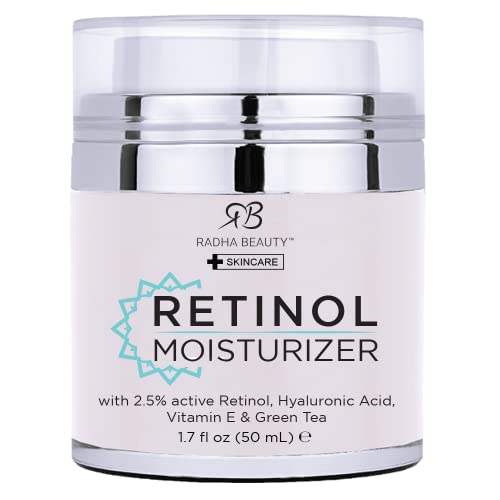
Radha Beauty Moisturizing Miracle Retinol Cream — Best Budget All-Rounder
Radha Beauty’s formula earns its reputation on reviews more than packaging. It pairs 2.5% retinol with hyaluronic acid, vitamin E, and green tea extract in a mid-weight cream that works for face and neck. At 2.5%, it’s on the higher end for OTC retinol, which means you’d want to start two to three nights per week and assess tolerance rather than jumping straight to nightly use. The supporting actives provide enough buffer that most buyers tolerate it without significant flaking. For someone wanting a higher retinol percentage without a clinical price tag, this is where the value is.
What to Look For in a Retinol Moisturizer
Vehicle quality determines tolerability. A retinol moisturizer with ceramides, fatty acids, and hyaluronic acid in the base is fundamentally different from one with water, glycerin, and filler emulsifiers. The former actively repairs barrier function as the retinol does its work. The latter just adds moisture. Look at the full ingredient list rather than the front label percentage.
Start slow regardless of the formula. Even well-buffered retinol moisturizers need an adjustment period. Two nights per week for four weeks, then increase. Most tolerance problems aren’t formula failures; they’re frequency problems. If your skin is still flaky after four weeks at twice weekly, the formulation is probably wrong for your barrier type, and switching is the right call.
SPF the next morning is non-negotiable. Retinol increases skin’s sensitivity to UV. Every morning after a retinol night requires broad-spectrum SPF 30 minimum, or you’re trading the anti-aging work of the evening for additional UV damage in the morning. This isn’t a suggestion. It’s the mechanism by which most retinol routines produce visible improvement.
Frequently Asked Questions
Is retinol moisturizer the same as a retinol serum?
Not exactly. Retinol serums typically deliver a more concentrated active in a lighter vehicle, often designed to absorb fast before a separate moisturizer. Retinol moisturizers combine the active and the hydration step, which is more convenient and often more tolerable for dry or sensitive skin. The results are comparable if you pick based on your skin’s needs.
How often should I use retinol moisturizer?
Start two to three nights per week and maintain that for four to six weeks before increasing. Daily use is appropriate for most people once tolerance is established, but pushing frequency before your skin adapts is the leading reason people experience excessive dryness and quit.
Can retinol moisturizer be used under the eyes?
A low-concentration retinol moisturizer can be applied to the orbital bone area, but not directly on the eyelid. The under-eye skin is thinner and more reactive. A formula specifically formulated for the eye area is a better choice if that’s your target zone.
Will retinol moisturizer cause purging?
Some people experience a brief purging phase in weeks two through four, where cell turnover acceleration brings congestion to the surface. This is temporary and different from a reaction or allergy. If breakouts persist past six weeks, the formula may be comedogenic for your skin type rather than causing true purging.
Can I use retinol moisturizer with niacinamide?
Yes. They work well together. Niacinamide helps buffer the irritation some users experience with retinol while adding barrier and sebum-regulating benefits. If you’re not using a formula that already combines them, applying niacinamide first and retinol moisturizer after is a well-tolerated pairing.
Bottom Line
SimplyVital’s collagen-forward formula is the most accessible pick for everyday dry-to-normal skin. CeraVe’s ceramide base makes it the right call for barrier-focused users. Neutrogena delivers visible results fastest for those already comfortable with retinoids. NatureWell handles the body retinol category without a dedicated competitor. Radha Beauty is where the value lands for buyers wanting a higher retinol percentage at a lower cost. Pick based on your current tolerance level, commit to two nights per week for a month, and follow every morning with SPF.